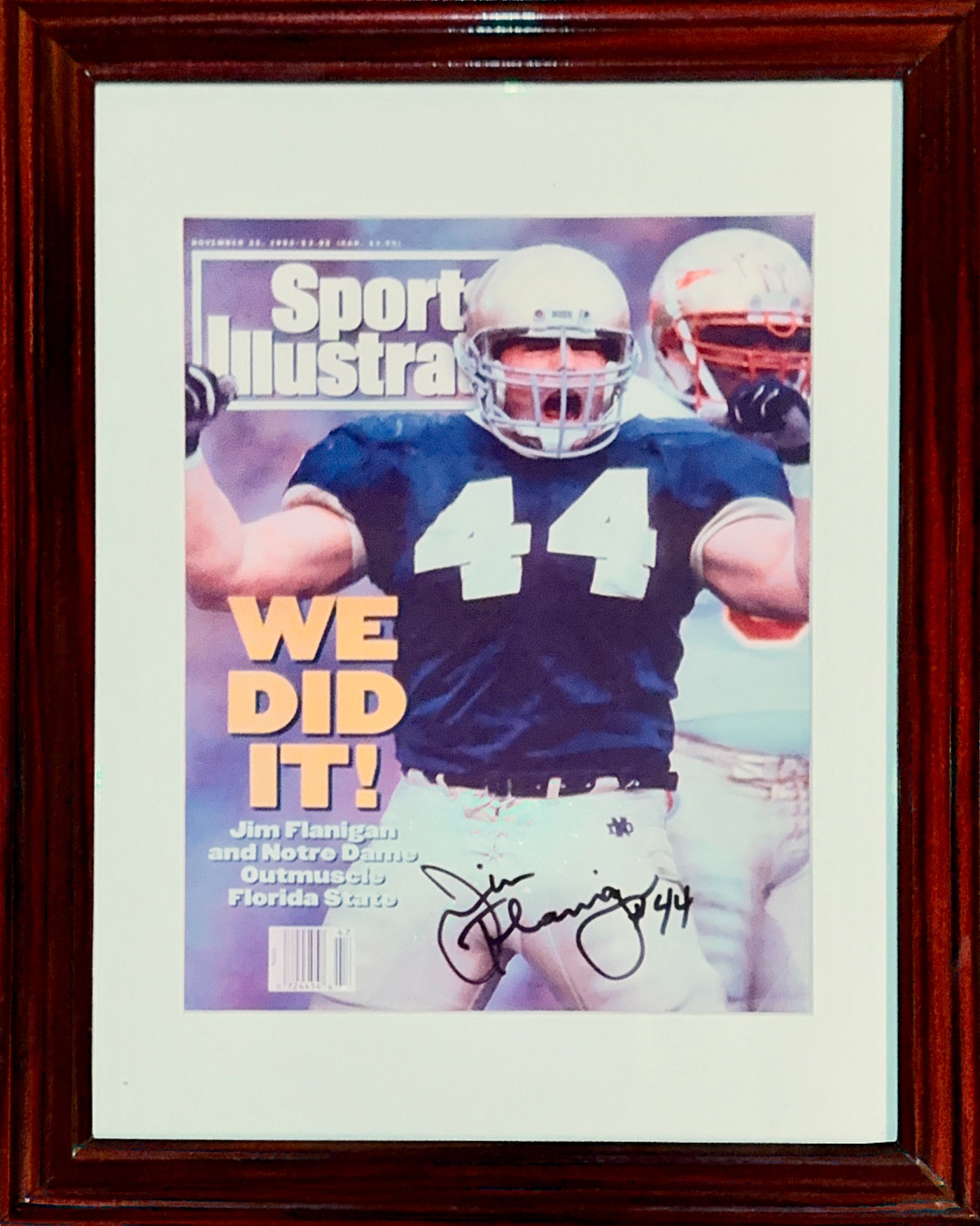
Some performances announce themselves with a sack celebration, a turnover, or a last-second play that lives forever on highlight reels. Jim Flanigan Jr.’s work against Florida State on November 13, 1993, was different. It happened in the crowded, violent middle of the field—exactly where Notre Dame needed it.
The game has long since passed into Irish mythology. No. 1 Florida State arrived in South Bend unbeaten, averaging 44.3 points per game and powered by Charlie Ward’s then-unusual “fast break” offense. No. 2 Notre Dame answered with old-fashioned force, built a 21–7 halftime lead, and survived the Seminoles’ late charge for a 31–24 victory.
A hard assignment in the heart of the defense
Florida State wanted to spread the field, create space, and make Ward impossible to contain. Notre Dame’s defensive line had to do more than chase him. It had to keep its shape, control the running lanes, and prevent the Seminoles from turning every snap into open-field chaos.
Flanigan, a senior defensive tackle, was central to that work. Playing alongside Bryant Young, he helped make the interior of Notre Dame’s defense a place Florida State could neither comfortably run through nor calmly pass behind.
The official numbers were sturdy rather than gaudy: Flanigan finished with four tackles—three solo—and two tackles for loss. Young was credited with the two sacks of Ward, and it is important not to borrow those headlines for Flanigan. His contribution was the complementary work that made the whole front effective: penetration, disruption, leverage, and pressure from the middle.
Young and Flanigan “seemed to be everywhere.”
The Observer, November 15, 1993
The numbers behind the disruption
Florida State moved 89 yards for a touchdown on its opening possession. Then the Irish defense tightened. In the second quarter, the Seminoles managed only 38 yards on 17 plays and committed two turnovers while Notre Dame seized control of the game.
By the end, Florida State had been held to 96 rushing yards. Ward gained 38 of them himself; the Seminole running backs combined for only 58. That lack of balance mattered enormously. Notre Dame could keep Ward in the pocket, compress the field, and make one of the most explosive offenses in the country operate under constant strain.
This is where Flanigan’s two tackles for loss tell only part of the story. Interior defensive-line play is often measured by what never develops: the crease that closes before a back reaches it, the quarterback forced to reset, or the blocker occupied long enough for a teammate to finish the play. The contemporary account praised Notre Dame’s defensive line for a great pass rush against a great quarterback. Flanigan’s afternoon belonged to that collective achievement.
Fifty-one seconds from history
Notre Dame led 31–17 before Ward pulled Florida State within seven. When the Irish offense could not run out the clock, the Seminoles got the ball back at their own 37-yard line with 51 seconds remaining. Ward drove them to the Notre Dame 14. Thomas Knight batted down one pass; Shawn Wooden knocked away the final throw at the goal line as time expired.
Wooden’s deflection supplied the unforgettable ending. But the ending was possible because Notre Dame’s defense had spent the afternoon refusing to let Florida State play the game it preferred. Flanigan’s work in the middle was part of that refusal from the first quarter to the last.
A performance worthy of the moment
The victory moved Notre Dame to 10–0 and to No. 1 in the polls. It also reinforced something easy to forget amid the mystique surrounding the “Game of the Century”: the Irish did not win because of ghosts. They won because players such as Jim Flanigan Jr. executed demanding assignments against extraordinary opponents.
Flanigan would be selected by the Chicago Bears in the third round of the 1994 NFL Draft and build a decade-long professional career. On that November afternoon in South Bend, however, he was simply an Irish defensive tackle doing indispensable work in the least glamorous part of the field—and helping hand the nation’s best team its first loss.
Notre Dame’s 31–24 victory is remembered for the noise, the stakes, the final pass, and the crowd pouring onto the field. It should also be remembered for the men who made the middle impassable. Jim Flanigan Jr. was one of them.
Sources
- Notre Dame Athletics: “Onward Notre Dame: 1993 Game of the Century”
- The Observer, Football Monday, November 15, 1993
- UPI Archives: Notre Dame 31, Florida State 24
- Pro Football Reference: Jim Flanigan
Discover more from Welcome to Notre Dame
Subscribe to get the latest posts sent to your email.
 Welcome to Notre Dame
Leave a comment